


Spray foam insulation delivers year-round comfort in Norfolk, MA because it combines high thermal resistance with air sealing in a single application, addressing both the conductive and convective heat loss that New England homes face across four distinct seasons. Norfolk sits in IECC Climate Zone 5, where January temperatures average around 30°F near the coast and summer highs regularly reach the low 80s. That 50-degree seasonal swing demands an insulation strategy that works in both directions, resisting heat loss in winter and heat gain in summer. Spray foam insulation in Norfolk, MA, accomplishes this by expanding into gaps, cracks, and penetrations that traditional batts and loose-fill materials cannot fully seal.
Massachusetts experiences cold, snowy winters and warm summers, with highly variable weather patterns driven by the jet stream’s position near the state. According to the NOAA/NCSU State Climate Summary for Massachusetts, average July temperatures in eastern portions of the state reach the mid-70s, while January temperatures near the coast hover around 30°F. Annual precipitation ranges from 45 to 55 inches across the state, with Norfolk County receiving its full share of rain, snow, and coastal storms.
Temperatures in Massachusetts have risen almost 3.5°F since the beginning of the 20th century, and the number of hot days (90°F or higher) has been consistently above average since 2010. The number of warm nights (minimum temperature of 70°F or higher) has been steadily increasing since 1995. For Norfolk homeowners, this means insulation must now handle more intense heat waves in summer while still protecting against freezing winters.
The Wikipedia article on building insulation notes that insulation reduces unwanted heat loss or gain and decreases the energy demands of heating and cooling systems. It also highlights that insulation is an important economic and environmental investment, especially when buildings are heated by oil, natural gas, or grid electricity. In a climate like Norfolk’s, where both heating and cooling systems run during the same year, the insulation choice affects comfort and energy bills across every month.
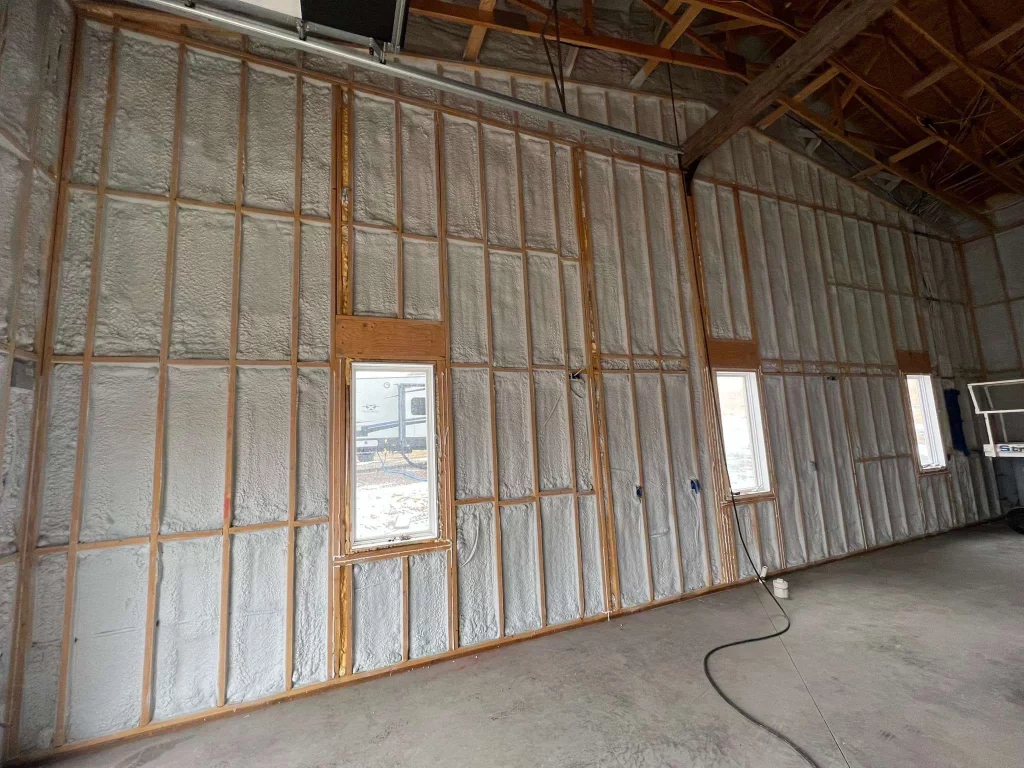
The core difference between spray foam and conventional insulation comes down to how it’s installed and what it does after curing. Spray polyurethane foam is applied as a two-component mixture that expands at the tip of a gun, filling wall cavities, sealing penetrations, and conforming to irregular surfaces. As the Wikipedia entry on building insulation materials explains, spray foam “blocks airflow by expanding and sealing off leaks, gaps and penetrations” and “expands while curing, filling bypasses, and providing excellent resistance to air infiltration.”
This air sealing capability matters because, as noted in the article on weatherization, “whereas insulation primarily reduces conductive heat flow, weatherization primarily reduces convective heat flow.” Most insulation materials handle conduction well but do little to stop air movement through the building envelope. Spray foam addresses both mechanisms simultaneously.
| Property | Closed-Cell Spray Foam | Open-Cell Spray Foam |
|---|---|---|
| R-value per inch | R-5.5 to R-6.5 | R-3.6 |
| Moisture resistance | Non-porous, acts as vapor barrier | Permeable to water vapor |
| Density | High (structural rigidity) | Low (soft when cured) |
| Air sealing | Excellent | Excellent |
| Sound dampening | Moderate | Superior |
| Best application | Basements, crawl spaces, exterior walls | Interior walls, attics, sound isolation |
Closed-cell foam offers higher thermal resistance per inch, making it the practical choice when cavity depth is limited, such as in 2×4 wall framing common in older Norfolk homes. Its moisture resistance also makes it well suited for basements and crawl spaces where groundwater and humidity are concerns.
Open-cell spray foam expands more during application, filling cavities thoroughly and providing better sound dampening. It allows moisture vapor to pass through, which can be advantageous in wall assemblies that need to dry in one direction. Both types seal air leaks effectively, which is the primary advantage over traditional materials.
The R-value measures thermal resistance, with higher numbers indicating better insulating performance. The following comparison shows how spray foam compares to common alternatives on a per-inch basis:
| Insulation Material | R-Value per Inch | Air Sealing Ability | Moisture Resistance |
|---|---|---|---|
| Closed-cell spray foam | 5.5 to 6.5 | Excellent | Non-porous |
| Open-cell spray foam | 3.6 | Excellent | Vapor permeable |
| Fiberglass batts | 3.1 to 4.3 | Poor (gaps around penetrations) | Loses effectiveness when wet |
| Cellulose loose-fill | 3.0 to 3.8 | Moderate (dense-pack better) | Absorbs moisture |
| Mineral wool batts | 3.0 to 3.85 | Moderate | Resistant but can clump when wet |
| Expanded polystyrene (EPS) | 3.85 to 4.2 | None (rigid board only) | Varies by density |
The per-inch R-value tells only part of the story. The R-value article notes that “air infiltration can allow convective heat transfer or condensation formation, both of which may degrade the performance of an insulation.” Fiberglass batts rated at R-13 may perform well in a lab but lose effectiveness in real-world walls where air moves through gaps around electrical boxes, plumbing penetrations, and framing. Spray foam insulation applications demonstrate how foam can address these vulnerable areas by eliminating gaps during installation.
In a Norfolk winter, the temperature difference between a heated living room (around 68°F) and the outdoors (potentially 15°F or lower) can exceed 50 degrees. That large delta drives rapid heat loss through any unprotected part of the building envelope. Spray foam addresses this in two ways: the foam itself resists conductive heat transfer through its high R-value, and the seal it creates prevents warm indoor air from escaping through cracks and penetrations.
The building insulation article from Wikipedia notes that thermal bridges, created when materials like wood studs and metal fasteners form continuous paths across a temperature difference, are a common source of poor energy performance. Spray foam applied against sheathing or directly in stud cavities reduces these thermal bridges better than batt insulation that leaves gaps at framing members.
Norfolk summers bring warm, humid air that can make poorly insulated homes uncomfortable even with air conditioning running. The NCICS climate summary reports that warm nights in Massachusetts have been increasing since 1995, meaning homes retain more heat overnight. Spray foam’s air seal prevents hot, humid outdoor air from infiltrating wall cavities and attic spaces, reducing the cooling load on HVAC systems.
Closed-cell foam in particular helps manage summer moisture. Its non-porous structure prevents humid air from reaching cooler surfaces inside the wall assembly where condensation could form. This is especially relevant in Norfolk, where summer humidity levels regularly create conditions for hidden moisture problems in poorly sealed walls.
The shoulder seasons in Norfolk bring rain, temperature swings, and intermittent heating or cooling needs. Spray foam’s continuous seal prevents the drafts that make these months unpredictable. Homes with spray foam insulation maintain more stable indoor temperatures during the 40-degree swings that are common between a sunny afternoon and a clear March night.
| Scenario | Recommended Approach | Why |
|---|---|---|
| Older home with 2×4 walls, drafty | Closed-cell spray foam in wall cavities | Maximizes R-value in limited depth, seals decades of air leaks |
| New construction with 2×6 walls | Open-cell spray foam in walls, closed-cell in basement | Balances cost efficiency with air sealing and moisture control |
| Attic retrofit | Open-cell spray foam at roofline | Fills irregular framing, seals top plates and penetrations |
| Basement or crawl space | Closed-cell spray foam on rim joist and walls | Moisture resistance and high R-value in contact with ground moisture |
| Home office or media room | Open-cell spray foam in walls | Superior sound dampening plus thermal performance |
Coleman Spray Foam helps Norfolk, MA homeowners achieve consistent, season-to-season comfort with professional spray foam insulation installation. Whether your home needs air sealing in drafty wall cavities, moisture control in a basement, or a full insulation upgrade, our team assesses your building envelope and recommends the right approach for your specific situation. Reach out to us at [email protected] or call (781) 730-6537 to discuss your project.
Request a Quote · Schedule an Insulation Assessment
Yes. Spray foam resists heat transfer in both directions and seals air leaks that let humid summer air infiltrate, reducing cooling loads alongside heating demands.
Closed-cell foam is denser, offers higher R-value per inch (R-5.5 to R-6.5), and resists moisture. Open-cell foam is lighter, less expensive per square foot, and provides better sound dampening with an R-value around 3.6 per inch.
In many cases, yes. Our technicians can access wall cavities through small holes drilled in exterior or interior surfaces, then patch and finish after the foam cures.
Because spray foam creates a tight building envelope, some homes may benefit from mechanical ventilation to maintain healthy indoor air quality. We evaluate this during our assessment.
Zone 5 requires higher R-values for walls, attics, and basements than warmer zones. Spray foam’s high R-value per inch makes it easier to meet or exceed these requirements within standard framing depths.