
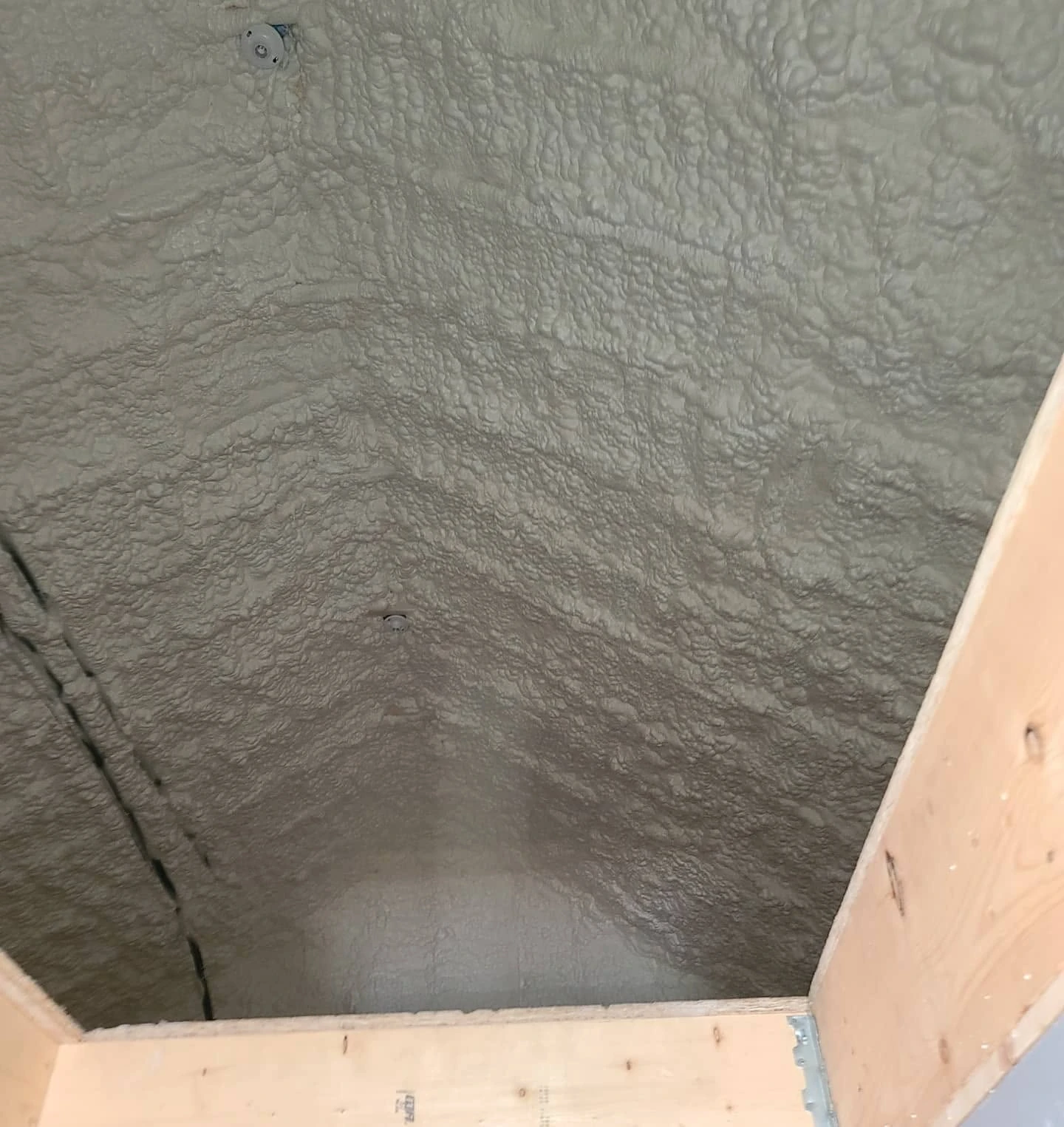
If you have ever lived in a home where one room is freezing in winter while another feels like a sauna, you already understand why insulation matters. Most homeowners assume the insulation behind their walls is doing its job, but the reality is that up to 40% of a home’s energy is lost through air infiltration, according to the U.S. Department of Energy. That is not just uncomfortable. It is expensive. Spray foam insulation tackles this problem differently than any other material on the market. Rather than simply layering material into wall cavities and hoping it fills the gaps, spray foam expands on contact, sealing cracks, crevices, and penetrations that traditional insulation simply cannot reach.
This guide is the product of years of hands-on experience installing spray foam in homes, crawlspaces, attics, and commercial buildings. We have seen what works, what fails, and what homeowners almost always get wrong when they try to compare insulation options. By the end of this guide, you will understand exactly how spray foam insulation works, which type is right for your project, where it makes the biggest impact, and how to ensure a safe and effective installation.
Spray foam insulation is a two-component chemical mixture, typically isocyanate (the “A-side”) and a polyol resin blend (the “B-side”), that is combined at the tip of a spray gun and applied to surfaces as a liquid. Within seconds, the mixture reacts, expands, and hardens into a solid foam that adheres to virtually any surface it touches. This expansion is what gives spray foam its unique advantage. Unlike fiberglass batts or blown cellulose that sit in wall cavities, spray foam actively fills gaps around pipes, wires, electrical boxes, and framing irregularities.
The U.S. Department of Energy’s Insulation Fact Sheet classifies spray foam as a professional-grade insulation product because it requires specialized equipment to meter, mix, and apply correctly. The fact sheet notes that foam insulation can be applied by a professional using special equipment and that it is particularly effective at filling closed cavities and oddly shaped areas where other insulation types leave gaps.
There are two fundamental categories of spray foam insulation, open cell and closed cell, and the distinction between them matters far more than most people realize. We will explore both in detail shortly.
Key Takeaways
To understand why spray foam outperforms other insulation, you need to understand two separate properties: thermal resistance and air sealing.
R-value measures how well a material resists the flow of heat. The higher the R-value, the better the insulation. The DOE’s Insulation Fact Sheet explains that R-value depends on the type of material, its thickness, and its density. For spray foam specifically, the R-value per inch is among the highest of any insulation material. Closed cell spray foam delivers approximately R-6 to R-7 per inch, while open cell spray foam comes in around R-3.5 to R-4 per inch.
But R-value alone does not tell the full story. The DOE fact sheet makes an important point that is often overlooked: insulation which is compressed will not give its full rated R-value, and insulation placed between studs does not stop heat from flowing through the studs themselves, a problem known as thermal bridging. Spray foam, particularly closed cell, helps reduce thermal bridging because it completely encapsulates framing members.
This is where spray foam truly separates itself from the pack. The DOE fact sheet states that insulation reduces air movement only within the space it occupies. It will not reduce air movement through other cracks between building parts. Fiberglass and cellulose, no matter how thick, allow air to pass through and around them. Spray foam, on the other hand, creates a monolithic seal. When it expands, it fills the tiny cracks and gaps where most of your home’s air leakage actually occurs.
The EPA’s “Seal and Insulate with ENERGY STAR” program notes that sealing and insulating the envelope of your home is often the most cost-effective way to improve energy efficiency and comfort. Their guidance states that a knowledgeable homeowner or skilled contractor can save up to 20% on heating and cooling costs by properly sealing and insulating.
Expert Tip: Before adding any insulation to an existing attic, seal the air leaks first. Insulation placed over unsealed gaps can actually hide the leaks and make them harder to fix later. Spray foam does both at the same time, which is one of the reasons it is so effective in retrofit applications.
The single most common question we hear from homeowners is about the difference between open cell and closed cell spray foam. Both are spray-applied polyurethane, but they perform very differently. Choosing the wrong type for your application is a mistake that can cost you comfort, money, or both.
Open cell spray foam is a low-density material with a sponge-like structure. The cells within the foam are broken or open, which gives the foam its soft, flexible texture. Here are the key characteristics:
Open cell spray foam is most commonly used in interior wall cavities, ceilings, and attics where vapor permeability is desirable and where the higher R-value per inch of closed cell is not required.
Closed cell spray foam is a high-density material with a rigid, solid structure. The cells within the foam are closed and filled with a gas that enhances thermal resistance. Here are the key characteristics:
Closed cell spray foam is used where space is limited, where moisture control is critical, and where higher R-value per inch is needed. It is the go-to choice for basement walls, crawlspace encapsulation, metal buildings, and exterior continuous insulation applications.
| Feature | Open Cell Spray Foam | Closed Cell Spray Foam |
|---|---|---|
| R-Value per Inch | ~3.5 to 3.7 | ~6.0 to 6.5 |
| Density (lb/cu ft) | 0.4 to 0.5 | 1.7 to 2.0 |
| Expansion Ratio | ~100x | ~30 to 40x |
| Vapor Permeability | Vapor permeable | Vapor barrier |
| Sound Dampening | Excellent | Good |
| Structural Rigidity | Low | High |
| Moisture Resistance | Absorbs water | Resists water |
| Typical Thickness for R-13 | ~3.5 inches | ~2 inches |
| Best Applications | Walls, attics, ceilings | Basements, crawlspaces, exterior sheathing, metal buildings |
Key Takeaways
The numbers tell the story. The EPA’s Seal and Insulate program confirms that sealing air leaks and adding insulation can save up to 20% on heating and cooling costs. Oak Ridge National Laboratory (ORNL), a DOE research facility, has conducted extensive testing on attic systems and found that homeowners who seal leaky HVAC ducts and attic penetrations with spray foam can save over $460 per year in energy costs. The DOE’s Insulation Fact Sheet notes that heating and cooling account for 50 to 70% of the energy used in the average American home, and that inadequate insulation and air leakage are the leading causes of energy waste.
When we look at the global picture, the spray foam insulation market reached approximately $2.3 billion in 2024 and is projected to grow to $4 billion by 2030 at a compound annual growth rate of about 5%. This growth reflects increasing awareness among homeowners and builders that traditional insulation methods are not enough to meet modern energy codes and comfort expectations.
The EPA’s Seal and Insulate guide identifies air leaks through attics, basements, and crawlspaces as “usually bigger problems” than obvious leaks around windows and doors. These hidden leaks travel through gaps around electrical outlets, plumbing penetrations, utility chaseways, and framing connections. Spray foam is uniquely suited to seal these pathways because it expands into the exact shape of each gap and hardens in place, creating a permanent air barrier.
Moisture is one of the most damaging forces in any building. The DOE fact sheet devotes an entire section to moisture control, noting that wet insulation does not work well and that mold and mildew grow in moist areas, causing allergic reactions and structural damage. Closed cell spray foam acts as a moisture barrier, preventing condensation from forming inside wall cavities and on cold surfaces. Open cell foam, while permeable to vapor, still reduces air movement that carries moisture through assemblies.
Expert Tip: In humid climates, closed cell spray foam applied to the underside of roof decking in unvented attics can prevent the condensation problems that plague vented attics during hot, humid summers. This approach turns the attic into a conditioned space, which also protects HVAC ductwork from extreme temperatures.
Closed cell spray foam has a density and rigidity that can actually strengthen the assembly it is applied to. When sprayed into wall cavities, it bonds to both the interior and exterior sheathing, effectively “gluing” the wall together. In hurricane-prone regions, this can contribute to a building’s resistance to wind uplift forces. This is a benefit that no other common insulation material provides.
The open structure of open cell spray foam absorbs airborne sound, reducing noise transmission through walls and ceilings. This makes it a popular choice for home theaters, offices, and multi-family housing where sound privacy matters. While it is not a substitute for dedicated acoustic treatments in commercial recording studios, it provides noticeable everyday sound reduction in residential applications.
Not every surface in your home is a candidate for spray foam, and knowing where it delivers the most value helps you prioritize your investment.
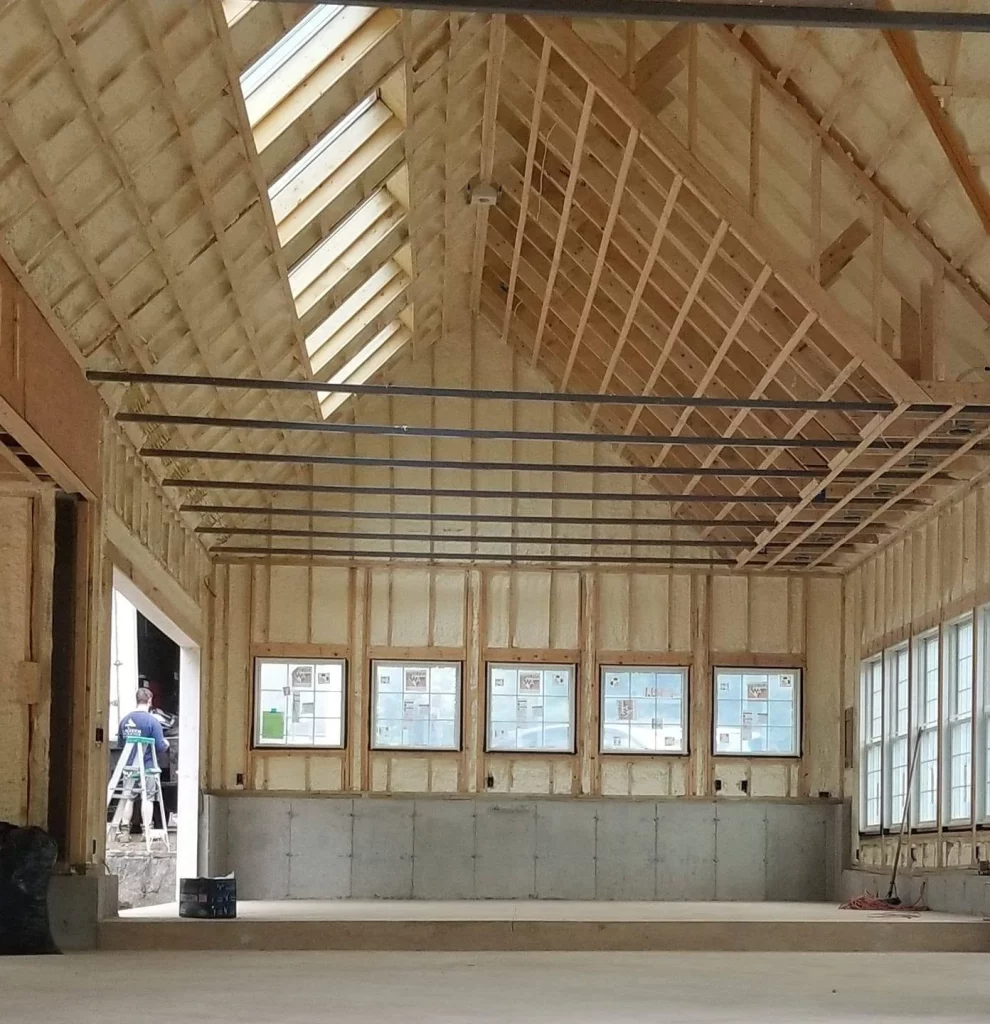
Attics are the single most impactful location for insulation upgrades. The DOE fact sheet explains that the attic is often the best place to stop air leaks because the tendency for warm air to rise drives many leakage paths upward. Spray foam can be applied in two fundamentally different attic strategies:
Traditional vented attic: Foam is sprayed on the attic floor, sealing penetrations and filling cavities above the living space. The attic remains ventilated.
Unvented conditioned attic: Closed cell foam is sprayed directly on the underside of the roof decking, sealing the attic envelope and bringing it into the conditioned space. This approach eliminates the energy penalty of ductwork and air handlers located in unconditioned attic space. ORNL’s research showed that poorly sealed HVAC ducts in attics typically cost homeowners $100 to $300 per year in wasted energy.
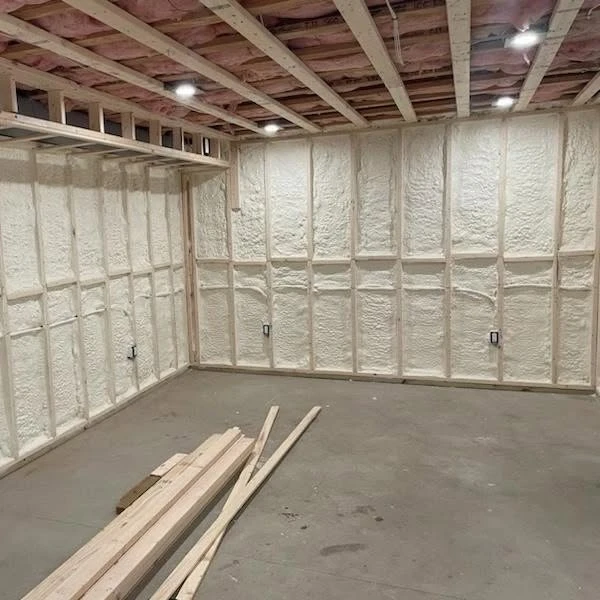
Spray foam in wall cavities fills around electrical boxes, plumbing runs, and framing irregularities that cause fiberglass batts to leave gaps. In new construction, open cell spray foam is commonly used in interior and exterior wall cavities. For retrofit applications in existing homes, we drill small holes through the exterior sheathing or interior drywall and inject foam into each cavity, then patch the holes.
Crawlspaces are one of the most problematic areas in a home. They are often damp, poorly insulated, and connected to the living space through floor penetrations that allow moisture and conditioned air to move freely. The DOE fact sheet recommends that unvented crawlspaces be insulated on the interior walls rather than under the floor above, and spray foam is the most effective material for this application because it adheres to irregular masonry surfaces and seals the numerous penetrations found in crawlspace walls.
Basement walls are in direct contact with the earth, which means they are both cold and potentially damp. Closed cell spray foam applied to the interior side of basement walls provides insulation, an air barrier, and a vapor retarder in a single application. The DOE notes that insulation on the interior of basement walls should be covered with a thermal barrier, such as gypsum board, to meet fire codes.
Metal buildings present a particular insulation challenge because metal framing conducts heat rapidly, creating severe thermal bridging. Spray foam applied to the interior of metal building panels provides both continuous insulation and an air barrier that addresses this problem. In commercial construction, spray foam is also used in coolers, freezers, and food processing facilities where high R-values and moisture control are essential.
Expert Tip: When insulating a metal building, pay special attention to the connection between the foundation and the base of the metal panels. This joint is often a major air leakage path that spray foam can seal effectively.
The rim joist area, where the floor framing meets the exterior wall, is one of the most under-insulated and leaky areas in most homes. It is also one of the easiest to access from the basement or crawlspace. Spray foam is the ideal material here because it seals the many penetrations for plumbing, wiring, and HVAC that pass through the band joist area.
Understanding the installation process helps you set realistic expectations, prepare your home or building, and ensure the work is done correctly. Here is a step-by-step breakdown of what a professional spray foam installation looks like.
Before any foam is sprayed, a thorough assessment of the building is essential. Our team evaluates the areas to be insulated, checks for existing moisture problems, identifies electrical and plumbing penetrations, and determines the appropriate foam type and thickness. We also review the building’s ventilation needs, because adding spray foam significantly reduces air infiltration, which means the building may need mechanical ventilation to maintain indoor air quality.
Preparation involves covering surfaces that should not receive foam, protecting HVAC systems, sealing or covering vents and registers, and ensuring the work area is properly ventilated. Electrical panels, light fixtures, and any items in the spray zone are covered or removed. In attics, we may set up containment barriers to keep overspray contained.
The installation crew wears appropriate personal protective equipment, including respirators, as recommended by the EPA. The two chemical components are stored in separate drums or tanks, heated to the manufacturer’s specified temperature, and fed through hoses to the spray gun where they mix at the nozzle. The technician sprays the foam in even passes, building up the thickness layer by layer to the target depth. Each pass partially cures before the next is applied.
After application, the foam continues to react and cure. EPA’s guidance on spray polyurethane foam states that the foam may appear hardened or “tack-free” within a few seconds to a few minutes, but it is still curing and still contains unreacted chemicals at that stage. Some manufacturers recommend 24 hours after application before unprotected workers or building occupants re-enter. The actual curing time depends on several factors, including product formulation, foam thickness, temperature, and humidity.
The EPA notes that temperature and humidity play a critical role in curing and that improper workplace practices, such as failing to shut down the HVAC system during installation, can affect curing rates and lead to off-gassing concerns.
Once the foam has cured, any excess or over-sprayed material is trimmed. Our team inspects the coverage for uniformity, checks that target R-values have been achieved, and verifies that all areas specified in the scope of work have been properly insulated. We then review any necessary follow-up steps with the homeowner.
Expert Tip: Always ask your installer for product labels from each container used during the job. The FTC requires clear R-value labeling on all residential insulation products, and these labels document exactly what was installed and in what quantity.
Spray foam insulation is a powerful product, and like any chemical-based building material, it demands respect during and after installation. The EPA has published extensive guidance on the potential exposures associated with spray polyurethane foam, and every professional installer should be thoroughly familiar with this information.
The EPA identifies several exposure pathways during spray foam application. Inhalation of vapors and aerosols generated during spraying can exceed OSHA occupational exposure limits, which is why only trained applicators wearing proper protective equipment should be present during application. The EPA also warns that vapors and aerosols can migrate through a building if the area is not properly isolated and ventilated.
The EPA’s safety guidance lists the following potential health effects from exposure to isocyanates and other SPF chemicals during installation:
Once spray foam has fully cured, it is considered relatively inert, meaning it is chemically inactive. However, the EPA cautions that certain factors can impact curing rates, potentially leading to unreacted chemicals off-gassing over time. These factors include temperature, humidity, improper mixing or proportioning by the applicator, and excessive foam thickness.
The EPA also flags long-term safety considerations that homeowners should be aware of. Maintenance workers, including plumbers and electricians, should not heat or grind spray foam during future repairs, as this can generate toxic emissions. Building renovations or demolition that disturb cured foam can also create exposure risks.
One consequence of a tightly sealed building is reduced natural air exchange. The DOE fact sheet notes that when natural ventilation has been sharply reduced through air sealing, it may be necessary to provide fresh air ventilation to avoid buildup of stale air and indoor pollutants. Depending on how tight your building envelope becomes after spray foam installation, you may need a mechanical ventilation system, such as a heat recovery ventilator (HRV) or energy recovery ventilator (ERV), to maintain healthy indoor air quality.
R-value is the standard measure of insulation performance, but it has limitations. The DOE fact sheet makes the point that the effectiveness of an insulated wall or ceiling depends on how and where the insulation is installed. Insulation placed between studs does not stop heat from flowing through the studs themselves (thermal bridging), and insulation which is compressed will not deliver its full rated R-value.
Spray foam addresses both of these problems. It reduces thermal bridging by encapsulating framing members, and because it is sprayed in place rather than compressed into a cavity, it maintains its full R-value. Additionally, spray foam provides air sealing, which the DOE fact sheet treats as a separate and equally important function from the R-value of the insulation itself.
Research from Oak Ridge National Laboratory provides some of the most concrete data on spray foam performance. In their roof and attic system testing, ORNL found that poorly sealed HVAC ducts in attics typically waste $100 to $300 per year. Sealing those attic penetrations with spray foam and creating a conditioned attic space can save upward of $460 per year in energy costs.
When combined with the EPA’s estimate of up to 20% savings on heating and cooling from proper sealing and insulation, the case for spray foam in attics and building envelopes becomes clear. The savings are not theoretical. They have been measured and documented by the nation’s leading building science laboratories.
The DOE fact sheet provides recommended R-values for every climate zone in the United States, ranging from Zone 1 (hot, humid) to Zone 8 (cold, subarctic). In colder zones, higher R-values are recommended for attics, walls, and crawlspaces. Because spray foam delivers higher R-value per inch than most alternatives, it can achieve these targets in thinner applications, which is particularly valuable in retrofit situations where cavity depth is limited.
Expert Tip: In climate zones 5 and above (the colder regions of the U.S.), closed cell spray foam applied to the interior of basement or crawlspace walls typically delivers the best return on investment. In warmer climates, prioritize the attic first, as heat gain through the roof is the dominant cooling load driver.
After years of installing spray foam, we have seen the same mistakes repeated by homeowners and inexperienced installers alike. Avoiding these will save you money, discomfort, and frustration.
Using open cell foam in a basement or crawlspace where moisture is present can lead to water absorption and reduced performance. Using closed cell foam where vapor permeability is needed in a wall assembly can trap moisture and cause problems. Always match the foam type to the specific conditions of the application.
Some homeowners assume that adding insulation alone is enough. The DOE fact sheet is clear that air sealing should be done before or in conjunction with insulation. If you insulate without sealing, air can still move through and around the insulation, reducing its effectiveness significantly. Spray foam is the one material that does both simultaneously, which is why it performs so well.
Tightening a building envelope with spray foam without addressing ventilation can lead to indoor air quality problems. The DOE fact sheet recommends heat-recovery ventilators or other mechanical ventilation systems when a home has been tightened significantly. If your HVAC contractor does not bring up ventilation during the insulation discussion, ask about it.
Gaps, voids, or thin spots in spray foam coverage create thermal bridges that reduce the overall performance of the insulation. Professional installers are trained to achieve uniform coverage, but it is worth inspecting the work after installation, especially in hard-to-see areas like behind ductwork or in tight corners.
The EPA explicitly warns against re-entering a building before spray foam has fully cured. Some manufacturers recommend waiting 24 hours after professional application. Cutting foam before it is fully cured can release unreacted chemicals. Always follow the manufacturer’s guidance on re-occupancy times.
Understanding how spray foam compares to other common insulation materials helps you make an informed decision for your project.
| Insulation Type | R-Value per Inch | Air Sealing | Moisture Barrier | DIY Friendly |
|---|---|---|---|---|
| Closed Cell Spray Foam | 6.0 to 6.5 | Excellent | Yes | No |
| Open Cell Spray Foam | 3.5 to 3.7 | Excellent | No | No |
| Fiberglass Batt | 2.9 to 3.8 | Poor | No | Yes |
| Blown Cellulose | 3.1 to 3.8 | Moderate | No | Yes |
| Rigid Foam Board | 3.8 to 6.5 | Poor (joints leak) | Some types | Moderate |
| Mineral Wool Batt | 3.3 to 4.2 | Poor | No | Yes |
The table above highlights a critical point: spray foam is the only common insulation type that provides both high R-value and effective air sealing in a single application. Every other type requires a separate air-sealing step, often involving caulk, spray foam sealant, or weatherstripping applied in addition to the insulation itself.
Expert Tip: If you are comparing bids, make sure each contractor is quoting insulation to the same R-value. Comparing three inches of closed cell spray foam (R-18 to R-19.5) against R-13 fiberglass batts is not an apples-to-apples comparison. Ask every bidder for the target R-value and the product they plan to use.
You now have a thorough understanding of how spray foam insulation works, what separates open cell from closed cell, where it delivers the most value, how the installation process works, and how to keep your project safe and effective. Let us distill the most important points into a clear action plan.
Step 1: Identify your priorities. Are you focused on energy savings, moisture control, sound dampening, or all three? The answer will guide your choice between open cell and closed cell foam and help you prioritize which areas of your home to insulate first.
Step 2: Start with the attic. For most homes, the attic is the single highest-impact location for insulation upgrades. Air leaks, duct losses, and inadequate insulation in attics account for a disproportionate share of energy waste. ORNL’s research confirms that attic sealing and insulation deliver measurable, significant savings.
Step 3: Address the building envelope. After the attic, focus on rim joists, crawlspaces, and basement walls. These areas often have little to no insulation and significant air leakage, making them high-value targets for spray foam.
Step 4: Plan for ventilation. If your spray foam installation is going to significantly tighten your building envelope, discuss mechanical ventilation options with your contractor. An HRV or ERV may be needed to maintain healthy indoor air quality.
Step 5: Work with experienced professionals. Spray foam installation requires specialized equipment, training, and attention to safety protocols. Choose an installer who understands building science, follows EPA guidance, and stands behind their work.
This guide is here for you to reference whenever you need it. Bookmark it and come back to it as you plan your project.
Deciding on the right insulation for your home raises a lot of questions, and you deserve clear, honest answers. Our team has the experience and training to assess your building, recommend the best approach, and deliver a professional installation that performs for years to come. Reach out to Coleman Spray Foam at [email protected] or call us at (781) 730-6537 to discuss your project.
When properly installed, spray foam insulation is a permanent building material. It does not settle, sag, or degrade over time like fiberglass or cellulose. It maintains its R-value and its air-sealing properties for the life of the building.
It depends on the foam type. Closed cell spray foam acts as its own vapor barrier due to its low permeability. Open cell spray foam is vapor permeable and does not require a separate vapor barrier in most wall assemblies. In some climate zones, local building codes may have specific requirements.
Yes. For closed wall cavities, small holes are drilled through the exterior or interior surface and foam is injected into each cavity bay. This is a common retrofit technique that seals air leaks and fills voids left by fiberglass batts or empty cavities in older homes.
Once fully cured, spray foam is considered relatively inert by the EPA. The primary safety concerns involve exposure during and immediately after installation, when the chemicals are still reacting. Occupants should vacate during installation and follow the manufacturer’s re-occupancy guidelines, typically 24 hours for professional applications.
Properly cured spray foam does not emit harmful chemicals. However, because it dramatically reduces air infiltration, it can reduce the natural ventilation that older homes rely on. In tightly sealed homes, a mechanical ventilation system may be recommended to maintain fresh air exchange. This is a standard best practice, not a problem specific to spray foam.
Spray foam seals the gaps and cracks that pests like mice, insects, and other critters use to enter your home. While it is not a pesticide and should not be marketed as one, the comprehensive air sealing it provides significantly reduces entry points for common household pests.