

Professional soundproofing reduces unwanted noise transmission by combining mass, absorption, decoupling, and damping techniques tailored to each space. Whether the goal is blocking traffic noise from entering a home office, preventing HVAC vibrations from disrupting a bedroom, or isolating shared walls in a multi-family building, the right approach depends on the type of noise, the building assembly, and the desired level of quiet. Understanding soundproofing materials, methods, and costs can help property owners choose an effective solution based on their specific noise-control needs. A professionally installed solution addresses weak points that DIY treatments often miss, from electrical boxes and ductwork penetrations to structural flanking paths, delivering consistent results that make indoor environments genuinely livable.
Excessive noise is not just an annoyance. The World Health Organization classifies noise as the second-largest environmental cause of health problems after air pollution. According to WHO’s European noise fact sheet, chronic noise exposure contributes to sleep disturbance, cardiovascular effects, hearing impairment, and poorer work and school performance. Children are especially vulnerable, with studies showing consistent evidence that noise exposure harms cognitive development and academic achievement.
Research from Harvard T.H. Chan School of Public Health found that both nighttime and daytime noise from vehicles, trains, and aircraft was linked to increased cardiovascular disease risk, even among people who reported sleeping through the noise. The body still produces a stress response to sound, triggering hormone dysregulation that can lead over time to insulin resistance, hypertension, and other metabolic issues.
The WHO compendium on environmental noise estimates that in 2011 alone, approximately one million healthy life years were lost from traffic-related noise in western Europe. The compendium notes that excessive noise increases the risk for ischemic heart disease, hypertension, tinnitus, and cognitive impairment, with growing evidence linking it to adverse birth outcomes and mental health problems.
These findings make a clear case: investing in professional soundproofing is an investment in long-term health, not just comfort.
Sound travels as vibrational energy through air and through solid structures. Effective soundproofing must address both airborne noise (speech, television, traffic) and structure-borne noise (footsteps, machinery vibrations, plumbing). According to the Wikipedia overview of soundproofing, the main techniques include:
Each technique targets a different part of the sound transmission problem. A professional assessment identifies which methods will deliver the best results for a specific situation.
Sound Transmission Class (STC) is the standardized rating system used in the United States to measure how effectively a building assembly blocks airborne sound. According to the Wikipedia entry on Sound Transmission Class, STC is an integer rating derived from laboratory testing performed under ASTM E90 and classified under ASTM E413. The rating is based on transmission loss values measured at 16 standard frequencies between 125 Hz and 4000 Hz.
A higher STC number means better sound isolation. Here is a practical reference for interpreting STC values:
| STC Rating | What You Can Expect |
|---|---|
| 25 | Normal speech is fully understood through the partition |
| 30 | Loud speech is understood |
| 35 | Loud speech is audible but not intelligible |
| 40 | Loud speech is heard as a murmur |
| 45 | Loud speech is faintly audible |
| 50 | Loud sounds are faintly heard |
| 60+ | Strong soundproofing; most sounds do not disturb neighboring residents |
A standard interior wall with single drywall on each side of wood studs typically rates around STC 33 to 35. Achieving STC 50 or higher requires a combination of added mass, insulation within the cavity, decoupling, and careful sealing. Professional installers design assemblies to meet or exceed target STC ratings based on the client’s needs and the type of noise involved.
Different parts of a building require different treatment strategies. Here is a breakdown of common approaches by element:
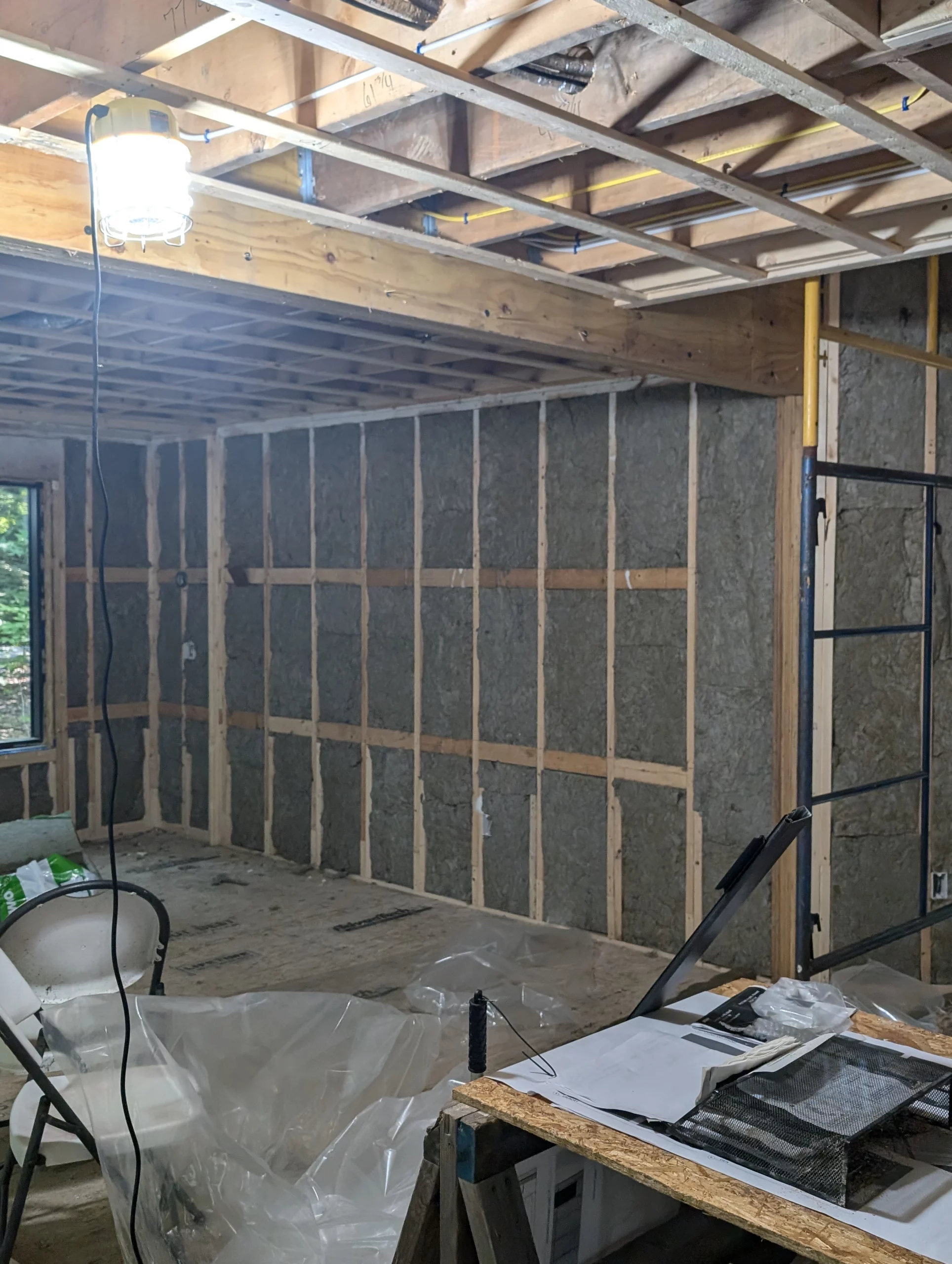
Walls: The most effective wall assemblies combine multiple techniques. Mineral wool insulation inside the cavity adds absorption. Adding a second or third layer of drywall with different thicknesses increases mass. Resilient channels or staggered-stud framing decouple the finished surface from the structural framing. Viscoelastic damping compounds between drywall layers further reduce transmission. Every electrical box, switch plate, and fixture perimeter must be sealed with acoustical caulk.
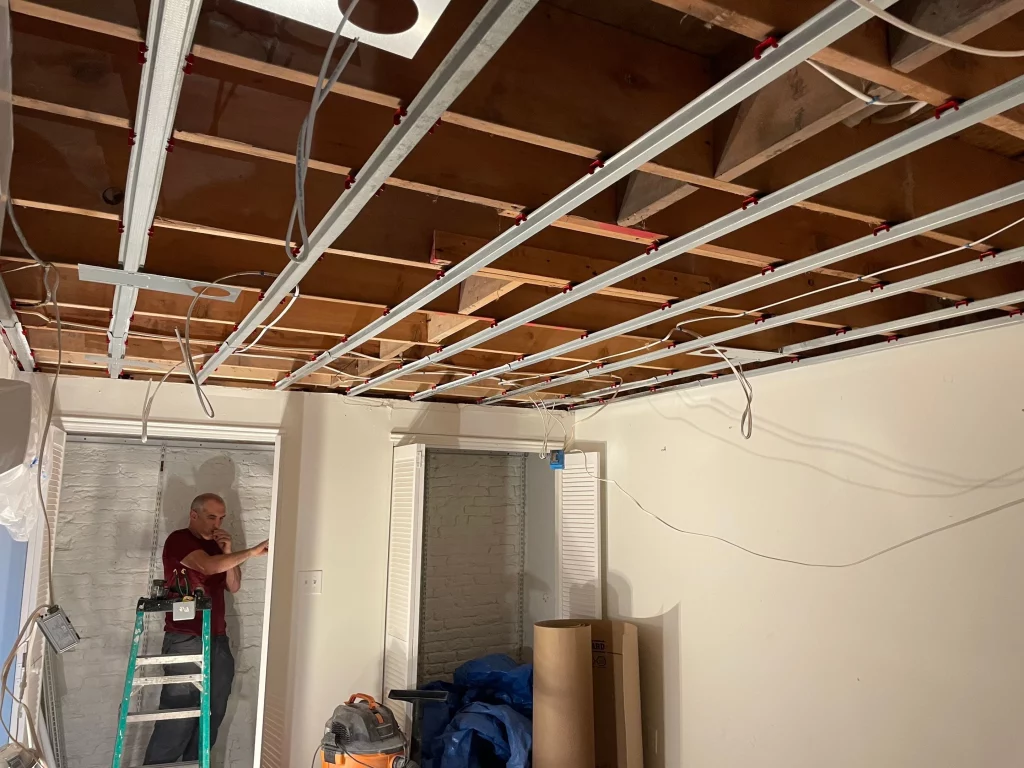
Ceilings: Ceiling soundproofing follows similar principles. Resilient isolation channels decouple the drywall from the joists, which is particularly effective for reducing impact noise from foot traffic above. Sealing gaps around duct registers, light fixtures, and wiring penetrations is essential as a preliminary step.
Floors: Decoupling the subfloor from joists using neoprene tape or rubber spacers, adding viscoelastic compounds between plywood layers, and installing mass-loaded vinyl with an underlayment all contribute to reducing both airborne and impact noise.
Windows and Doors: Solid-core doors outperform hollow doors. Double-pane or laminated acoustic glass with a vibration-damping interlayer improves performance against low-frequency traffic noise. Sealing the perimeter around doors and windows is critical because even small gaps allow significant sound leakage.
Many homeowners attempt soundproofing services with acoustic foam panels or egg-crate foam applied to walls. While these materials improve room acoustics by reducing reflections, they do not meaningfully block sound from passing through walls, ceilings, or floors. The absorption aspect of soundproofing is about filling cavities with dense fibrous insulation, not covering surfaces with foam.
Common DIY pitfalls include:
Professional installers assess the entire sound transmission path, identify weak points, and apply the right combination of techniques to achieve measurable results.
Different environments demand different soundproofing priorities. The table below outlines which approaches work best for common residential and commercial scenarios.
| Setting | Primary Noise Concern | Recommended Approach | Notes |
|---|---|---|---|
| Home offices | External traffic, indoor household activity | Seal windows and doors, add mineral wool in shared walls, use resilient channels on ceilings | Focus on airborne speech and traffic frequencies |
| Multi-family housing | Neighbors’ voices, TV, foot traffic | Mass-added walls, cavity insulation, decoupled ceiling assemblies, sealed penetrations | Target STC 50 or above for shared partitions |
| Bedrooms near roadways | Low-frequency traffic noise | Laminated acoustic windows, sealed wall assemblies, dense insulation | Low frequencies are hardest to block and require mass and damping |
| Home theaters | Sound escaping to other rooms | Room-within-a-room construction, multiple mass layers, decoupled framing | Prevents both sound leakage and external noise intrusion |
| Healthcare or office spaces | Speech privacy between rooms | High-STC wall assemblies, acoustic caulking at all penetrations | Speech intelligibility is the primary metric |
Choosing a professional soundproofing installer matters as much as selecting the right materials. Look for these indicators:
A strong partner will never promise complete silence, because true soundproofing is impractical in most real-world buildings. Instead, they set realistic expectations based on measurable STC improvements and the specific noise sources involved.
At Coleman Spray Foam, our team specializes in insulation and sound-dampening solutions that address the full range of noise transmission paths in residential and commercial buildings. We start with a thorough on-site assessment, identify the weakest points in your building envelope, and design a treatment plan using proven combinations of mass, absorption, decoupling, and sealing to deliver quieter, more comfortable indoor spaces.
Request a Quote | Schedule a Sound Assessment
Call us directly at (781) 730-6537 or email [email protected]. Our professionals are ready to evaluate your space and recommend the right soundproofing strategy for your needs.
Soundproofing blocks sound from passing through walls, ceilings, and floors using mass, absorption, decoupling, and damping. Acoustic treatment improves sound quality within a room by reducing echoes and reflections, but it does not stop sound transmission between spaces.
Spray foam is effective for sealing gaps and cracks that allow sound leaks, which is an important preliminary step. However, it is not porous enough to absorb sound or dense enough to block it on its own, so it works best as part of a broader strategy that includes mass and absorption materials.
Results depend on the existing construction, the type of noise, and the treatment methods used. A well-designed professional installation can raise an STC 33 wall to STC 50 or higher, which means loud speech on the other side drops from fully understood to barely audible.
Not always. Many treatments can be applied from one side, such as adding mass-loaded vinyl, resilient channels, and an additional drywall layer over existing walls. Sealing penetrations and adding blown-in insulation can also improve performance without demolition.
No. Professional soundproofing benefits any space where noise interferes with comfort, privacy, or productivity, including home offices, bedrooms near busy roads, multi-family housing, classrooms, healthcare facilities, and commercial offices.
5. Wikipedia entry on Sound Transmission Class: https://en.wikipedia.org/wiki/Sound_transmission_class